
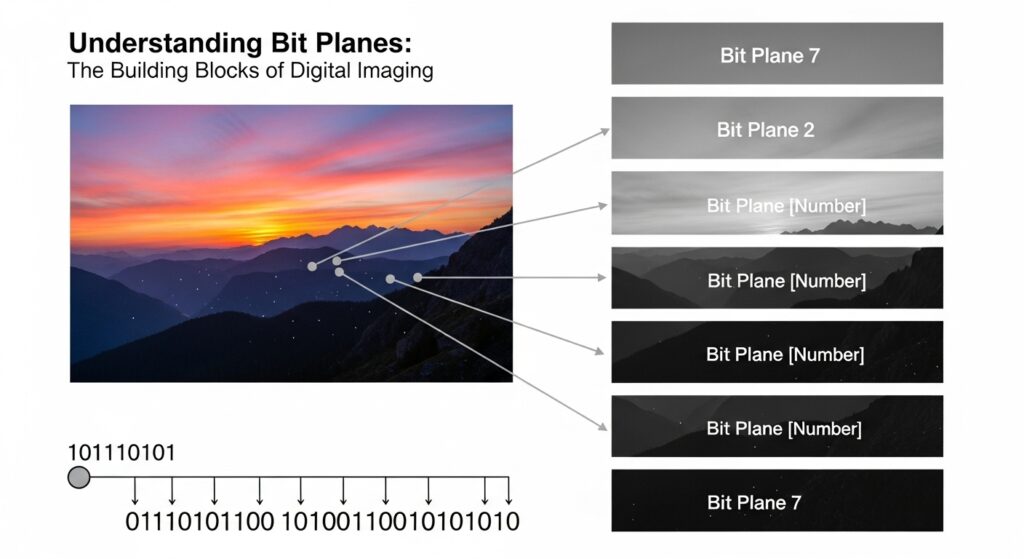
Digital imaging is everywhere, from the photos we snap on our smartphones to the graphics that power video games. But have you ever stopped to think about how these images are formed at a fundamental level? It’s all thanks to something called bit planes. Understanding bit planes helps demystify the digital world and reveals just how intricate imaging technology really is. So, let’s dive into this fascinating topic and discover what makes up the building blocks of your favorite visuals!
What Are Bit Planes?
Bit planes are an essential concept in digital imaging. They represent a structured way to store pixel data in images. Each bit plane corresponds to a specific bit position within the pixel values.
For example, consider an 8-bit image. It consists of eight distinct bit planes, ranging from the least significant bit (LSB) to the most significant bit (MSB). Each plane captures different levels of brightness and color information for every pixel.
By isolating these individual layers, one can analyze how each contributes to the overall image quality. This separation also aids in processing tasks such as filtering and enhancement.
Understanding bit planes helps demystify how digital images are constructed at their core level. It’s fascinating how something so foundational can have vast implications for image manipulation and analysis.
Why Are They Important in Digital Imaging?
Bit planes play a crucial role in digital imaging by providing a structured way to represent image data. Each bit plane corresponds to a specific level of brightness or color depth, allowing for precise control over pixel values.
This organization aids in efficient image processing and manipulation. By isolating different bits, software can easily adjust contrast, brightness, and other attributes without altering the entire image.
Moreover, bit planes facilitate various analysis tasks like segmentation and filtering. They enable algorithms to detect edges or prominent features within an image more effectively.
Their importance extends into compression techniques as well. By exploiting redundancies across bit planes, images can be stored with reduced file sizes while maintaining quality.
Understanding how bit planes function enhances the ability to work with digital images efficiently and creatively.
How Do Bit Planes Work?
Bit planes operate on the fundamental concept of binary representation in digital images. Each pixel in an image consists of bits, which can be either 0 or 1. When these bits are organized into layers based on their positions, you get bit planes.
For instance, consider an 8-bit grayscale image. It contains values ranging from 0 to 255 for each pixel. This means a total of eight bit planes exist—each plane corresponds to one bit position across all pixels.
By isolating individual bit planes, we can analyze how different levels contribute to the overall intensity and detail of the image. The most significant bits define brighter areas while less significant ones capture subtle variations and noise.
This layer-based approach allows for efficient processing and manipulation, making it easier to apply transformations without affecting the entire image at once. Understanding how these layers interact is essential for advanced imaging techniques.
The Role of Bit Planes in Image Compression
Bit planes play a crucial role in image compression, serving as essential tools for reducing file sizes without sacrificing quality. By isolating individual bits of pixel data, these planes allow algorithms to focus on the most significant information.
When compressing images, bit planes help identify patterns and redundancies within pixel values. This enables efficient encoding techniques that save space while preserving visual fidelity. For example, lower significance bits can often be discarded with minimal impact on perceived image quality.
Utilizing bit planes also facilitates lossless compression methods. These approaches ensure that the original image can be perfectly reconstructed from its compressed form. As a result, professionals working in fields like photography or graphic design benefit immensely from this technology.
As digital content continues to grow exponentially, understanding how bit planes enhance compression will become increasingly vital for optimizing storage and transmission efficiency across various platforms.
Applications of Bit Planes in Digital Imaging
Bit planes find diverse applications across various fields of digital imaging. They play a pivotal role in medical imaging, enhancing the clarity and detail of scans. Radiologists rely on bit plane analysis to differentiate between tissues, helping to identify anomalies.
In remote sensing, bit planes help process satellite images for land use classification or environmental monitoring. By isolating specific bits, analysts can extract meaningful data from complex imagery.
Video compression techniques also leverage bit planes to reduce file sizes without sacrificing quality. This is crucial for streaming services that need efficient delivery of high-definition content.
Moreover, computer graphics utilize bit planes to create rich textures and colors in 3D rendering. The ability to manipulate individual bits allows artists greater creativity while maintaining performance efficiency.
Even in machine learning applications involving image recognition, understanding bit planes enhances algorithms’ accuracy by focusing on significant features within pixel data.
Conclusion and Future Implications
Understanding bit planes opens up a fascinating world in digital imaging. These fundamental layers provide insight into how images are constructed, revealing the intricate details of pixel representation.
As technology advances, the role of bit planes is likely to evolve further. The growing demand for high-quality imaging—whether in medical fields or media production—will continue to highlight their importance. Innovations in image compression techniques may leverage bit plane strategies for more efficient data storage and transmission.
Future developments might also see enhanced applications across various sectors like virtual reality, machine learning, and artificial intelligence. As these technologies advance, understanding the underlying structures such as bit planes will be essential for optimizing visual experiences.
The journey through the realm of digital imaging isn’t just about pixels; it’s about grasping how foundational elements work together to create stunning visuals that enrich our lives. Embracing this knowledge can lead to exciting possibilities within an ever-evolving field.